There is a moment in every vehicle’s life when it stops being exempt and starts needing a Missouri safety inspection. Most owners never see it coming, because they remember only half of the rule. The half people remember is that newer vehicles are exempt. The half they forget is that “newer” gets measured two different ways at the same time, and your vehicle only stays exempt while it satisfies both.
So if you drive an older sedan around Jefferson City, a work truck between California and Sedalia, or a farm rig that rarely leaves Moniteau County, the day your exemption ends is already sitting on the calendar or on the odometer. Knowing which one is coming first is the difference between a routine appointment and a surprise rejection.
The Rule Almost Everyone Gets Half Right
Missouri exempts motor vehicles having less than one hundred fifty thousand miles, for the ten-year period following their model year of manufacture. Read that sentence slowly, because the important word is silent: and.
Both conditions have to be true at once for the exemption to hold. Under ten years and under 150,000 miles. The moment either one fails, the exemption is over and the vehicle joins the regular inspection schedule.
That is where the confusion starts. People hear “ten years” and assume a low-mileage car is safe indefinitely. Other people hear “150,000 miles” and assume a newer vehicle is safe until the odometer says otherwise. Both are half right, which in practice means both are wrong, and it is the most misread part of the car inspection requirements in Missouri.
This exemption is not ancient history, either. It took effect on August 28, 2019, when the state extended the exemption window from five years following the model year to ten, on the condition that the vehicle has fewer than 150,000 miles. Plenty of vehicles around Cole, Camden and Pettis counties that were comfortably exempt when that change landed have since crossed one line or the other.
How Missouri Counts the Ten Years
The clock runs off the model year of manufacture. Not the day you bought the vehicle, and not the day it was first registered.
The Missouri Department of Revenue considers a vehicle to be 10 years old through December 31 of the 10th year following its manufacture year. So the window does not close on a birthday in the middle of the year. It closes at the end of a calendar year, which means you can work out the year your vehicle ages in without hunting for a specific date.
Picture a 2016 model-year sedan with 62,000 miles on it. Garaged, driven gently, serviced on time. The odometer is nowhere near the limit and probably never will be. None of that matters. The calendar catches this car anyway once the ten-year window following its model year closes.
This is the version of the cliff that surprises careful owners the most. Taking excellent care of a vehicle keeps it out of the shop for repairs. It does not keep it out of the inspection bay.
The Other Way In: 150,000 Miles
Now flip it around.
A 2021 half-ton pickup running a Jefferson City to Sedalia commute, plus job-site trips on top of that, piles on highway miles fast. At that rate it can cross 150,000 miles well before it is anywhere close to ten years old. When it does, the exemption ends on the odometer instead of the calendar, years earlier than the owner expected.
Small fleets, contractors, farm operations and anyone driving Highway 50 or Highway 54 every day tend to meet the mileage limit first. And the mileage test does not care about condition. A truck can be immaculate, freshly serviced and running perfectly at 150,000 miles. The number is the number.
So the practical question for every Mid-Missouri owner is this: which line is my vehicle going to cross first, the calendar or the odometer? Answer that once and the timing stops being a surprise.
Once You Are In: The Two-Year Cycle
Crossing either line does not mean an inspection every single year. Missouri runs a two-year cycle, and which years apply to you depend on your vehicle’s model year.
The schedule is keyed to whether your model year is even or odd, so an inspection falls due every other calendar year rather than annually. Your registration renewal notice tells you which year is yours, and the shop or the state can confirm it if you are unsure.
Timing inside those years matters too, and this is where people trip:
- The inspection cannot be made more than sixty days prior to the date of application for registration, or within sixty days of when a vehicle’s registration is transferred.
- A Certificate of Inspection and Approval is valid for 60 days starting with the date of inspection.
- One useful exception: if the vehicle was bought from a Missouri dealer and a valid inspection had been made within sixty days of the purchase date, the new owner can use an inspection performed within ninety days prior to the application.
So an inspection is not something to get done far in advance and file away. Line it up with your registration, not months ahead of it.
What a Missouri Safety Inspection Actually Covers
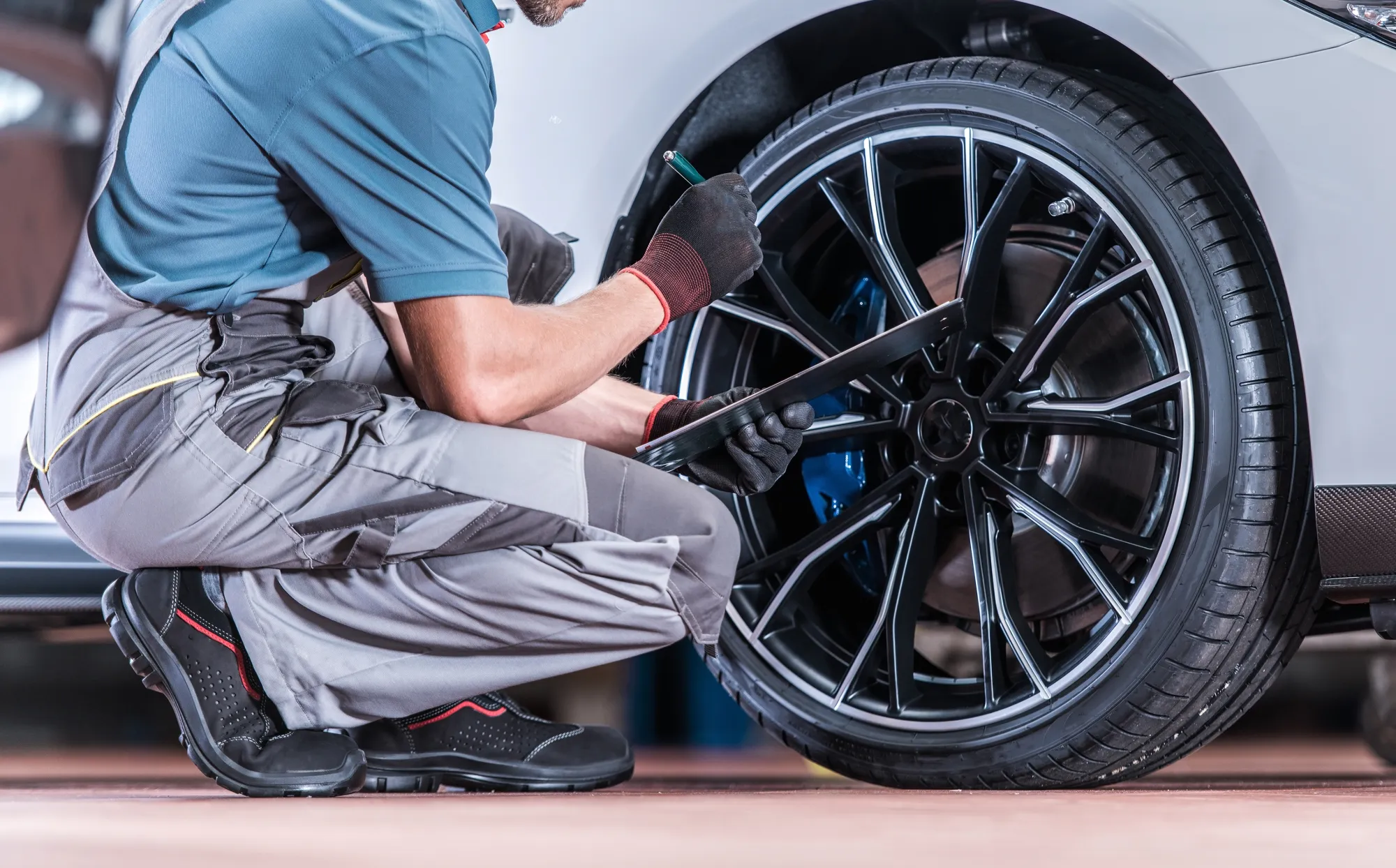
A Missouri safety inspection is a defined checklist, not one person’s opinion of your vehicle. The state sets out what gets examined: brakes, lighting equipment, signaling devices, steering mechanisms, horns, mirrors, windshield wipers, tires, wheels, exhaust system, glazing, air pollution control devices and the fuel system.
The Missouri State Highway Patrol’s inspection regulations manual goes further and gives each of those systems its own written rule, from brake performance and lighting to tires, wheels, glazing, mud flaps, seat belts and bumpers. That detail works in your favor: the outcome is measurable and knowable in advance. Here is where some of those lines sit:
- Tires. A tire is rejected if it is worn anywhere other than the wear indicator to the point where there is no tread configuration, if a localized worn spot exposes the cord, if a cut or separation exposes the cord when the tire is inflated, or if the tire has knots. A radial and a nonradial tire on the same axle is also a rejection, as is a tire marked reject or farm use only. Every Missouri station must keep a tread depth gauge graduated in one thirty-second inch increments, so tread is measured, not eyeballed. If you are already shopping, our tire buying guide walks through picking the right set.
- Brakes. Linings are rejected when the thinnest point of a bonded lining is less than 2/32″, when riveted lining is worn to less than 2/32″ above any rivet, or when bonded pads are worn at any one point to less than 2/32″.
- Wipers. All front windshield wipers, as equipped by the manufacturer, have to be in operating condition. Wipers that fail to function are a rejection item, full stop.
Notice what those three have in common. They are wear items. They get worse gradually, they take a minute to check, and none of them fail on inspection day for the first time. They have been heading that way for months.
Getting Ready for a Vehicle Inspection in Jefferson City, MO
The best inspection appointment is the boring one, and that happens when somebody has already walked the vehicle before the certificate is on the line. If you are searching for a vehicle inspection in Jefferson City, MO, or anywhere from California to Camdenton, have the wear items checked first.
Ask your shop to look at:
- Tread depth on all four tires, plus cuts, bulges, uneven wear and mismatched tire types on the same axle. Uneven wear is often a rotation problem, and regular tire rotations are the simplest way to keep tread even across the set.
- Brake pad and lining thickness at each wheel, along with how the vehicle actually stops. If something feels off, our brake service team can measure it properly.
- Every exterior lamp, front to back: headlights, tail lights, brake lights, turn signals, marker lights and the license plate lamp
- Wiper blades, including whether they clear the glass instead of smearing it
- Steering and suspension play, especially on a truck that lives on gravel roads
- The exhaust system end to end, for corrosion, leaks and loose hangers
- Windshield glass in the driver’s vision area, plus the horn and mirrors
If you drive a farm truck or a work truck out around Versailles, Clinton or Hollister, put steering and suspension play and exhaust corrosion at the top of that list. On vehicles that spend their lives on gravel and washboard, those are usually the deciding items, not the engine.
Doing this ahead of time also lets you decide calmly. You see what a repair involves and can ask us for a current quote on your specific vehicle, rather than standing in a lobby with a rejection notice and a deadline.
If the Vehicle Is Rejected
A rejection is not a disaster, and Missouri’s rules are more forgiving here than most people realize.
If the rejected vehicle is returned for a reinspection within twenty consecutive days, excluding Saturdays, Sundays and state holidays, no additional inspection fee can be charged for one reinspection. Better still, that reinspection consists of only the components that were rejected during the initial inspection. You are not starting from zero. The manual even requires the reinspection to begin within one hour when the vehicle is presented inside that window.
The common version plays out the way you would hope. A car gets rejected for a burned-out tail lamp and a worn wiper blade, the repairs happen that week, it comes back inside the window, and only those two items get rechecked. The trap is letting the window lapse. Miss it and you are back to a full inspection of the whole vehicle. So when something is flagged, book the repair right away.
Two Mid-Missouri Notes Worth Knowing
Emissions testing does not apply here. A vehicle is subject to an additional emissions inspection only if it is registered to operate in St. Louis City, St. Louis County, St. Charles County or Jefferson County. Drivers in Cole, Camden, Henry, Moniteau, Morgan, Pettis and Taney counties are dealing with the safety inspection alone.
Watch the name overlap. Jefferson County, south of St. Louis, is one of the emissions counties. Jefferson City, in Cole County, is not. Two very different places with similar names, and the distinction matters when you are reading up on car inspection requirements in Missouri online.
Frequently Asked Questions
My car has low miles. Do I still need an inspection?
Eventually, yes. The exemption requires both conditions at once, so a low-mileage vehicle still ages in once the ten-year window following its model year closes.
My vehicle is only a few years old but it has serious miles on it. Am I exempt?
Not once you pass 150,000 miles. The mileage limit ends the exemption on its own, regardless of how new the vehicle is or how well it has been maintained.
How do I know which years I am due?
The two-year cycle is keyed to whether your model year is even or odd, so you are due every other calendar year. Check your registration renewal notice, or ask us and we will confirm which year applies to your vehicle.
How long is my inspection certificate good for?
A Certificate of Inspection and Approval is valid for 60 days from the date of inspection, which is why it is worth timing the inspection to your registration rather than doing it early.
What does an inspection cost, and what would repairs run?
Inspection fees are set by the state, and repair costs depend entirely on what your specific vehicle needs. Rather than quote a number that may be out of date by the time you read it, contact us for a current quote on your vehicle, and check with the state on the inspection fee itself.
What if I fail?
Get the flagged items repaired and return within twenty consecutive days, excluding Saturdays, Sundays and state holidays. That reinspection covers only the rejected components, and no additional inspection fee can be charged for one reinspection.
Get Ahead of It
If your vehicle is coming up on ten years, or the odometer is closing in on 150,000 miles, now is the time to have the wear items looked at rather than after a rejection notice.
Bring it by any of our Mid-Missouri stores in Jefferson City, California, Camdenton, Clinton, Versailles, Sedalia or Hollister, and we will walk the tires, brakes, lights, wipers, steering, suspension and exhaust with you, then tell you plainly what needs attention and what can wait. For anything that does need work, request a quote and we will give you a current, vehicle-specific number before you commit to anything.